
We’re examining how India’s federal philosophy, as embedded in Schedule 4, plays out in practice:
Does India act like a Union of Citizens or a Federation of States?
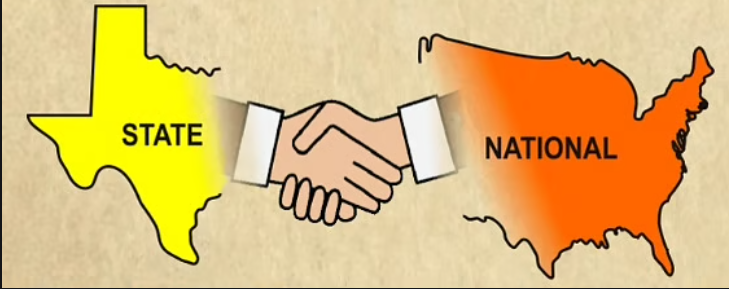
🧾 Example 1: GST Council — Who Decides Tax Matters?
What is the GST Council?
When India introduced the Goods and Services Tax (GST) in 2017, it had to change how taxes are decided across the country. Earlier, both the Union and states could impose their own taxes on goods and services. With GST, both sides gave up some of their powers and agreed to a common tax system.
To manage this new system, a special body was created — called the GST Council.
This council includes two main types of members:
-
The Union Finance Minister, who represents the central government.
-
The Finance Ministers of all the states, who represent their respective state governments.
They all sit together and decide things like:
-
What should be the GST rate on different products?
-
Which goods should be taxed higher or lower?
-
How should revenue be shared?
But who has more say?
Here’s where the power balance comes in.
To pass any decision in the GST Council, a special majority is required — not just a simple yes or no. Specifically:
-
The central government’s vote counts as 33% (or one-third).
-
All the state governments together have 66% (or two-thirds).
This might make you think: states have more power, right?
But here's the twist — any decision needs 75% agreement. That means the central government, with just its 33% vote, can block any decision. It has veto power, even though it’s only one member among many.
So what does this mean in reality?
During the COVID-19 crisis, the central government delayed giving GST compensation to states. Many states, like Kerala and Punjab, said that they were promised that their income from taxes would be protected. But the central government said, “There’s no money to give you right now.”
The states couldn’t force the Centre to act, even though they all agreed among themselves. The structure of the council gave the Centre enough power to block any decision it didn't like.
What does this tell us?
Even though the GST Council is a body where both the Centre and states sit together and talk, the design gives the Union government more power than any single state, or even a group of states. This reflects India’s overall approach to federalism — where states have a voice, but the final power remains with the Union.
🏞️ Example 2: River Water Disputes — Who Controls Shared Natural Resources?
Let’s take a real-world conflict: the Cauvery River, which flows through Karnataka and Tamil Nadu.
Both states need this water for agriculture, drinking, and industries. But the river’s water is limited, especially in years of drought. So, disputes keep coming up about how much water each state should get.
So what happens when states disagree?
They cannot settle it by themselves. The central government steps in and sets up a tribunal, a special legal body that studies the issue and gives a decision. But even after the tribunal gives a decision, it’s up to the Union government to notify it (i.e., officially accept it and implement it). Without this step, the decision has no legal force.
In the case of the Cauvery dispute, the tribunal gave its final verdict, but the central government delayed its notification. Tamil Nadu protested, saying it was suffering without water. Karnataka said it had its own problems.
Eventually, the Supreme Court had to order the central government to set up the Cauvery Water Management Authority to monitor the water-sharing process.
What does this tell us?
Even in natural resource disputes that directly affect states, the states do not have full control. The Union government acts like the final referee, and its cooperation is needed to enforce any solution.
So, once again, even when the Constitution says water is a “state subject,” the real power lies with the Union. This reflects the same central philosophy: the Union holds the tools to settle disagreements, not the states themselves.
🧩 Example 3: Abrogation of Article 370 — Can a State Be Removed?
Let’s talk about one of the most striking events in recent Indian political history: the removal of Article 370, which gave special status to Jammu and Kashmir (J&K).
Until 2019, J&K had its own Constitution, and Indian laws applied there only if the J&K Assembly agreed. The state had more autonomy than any other in India.
Then, in August 2019, the central government took two steps:
-
It removed Article 370, making all Indian laws fully applicable to J&K.
-
It split the state into two Union Territories — Jammu & Kashmir and Ladakh.
But how did the Union do this?
At that time, there was no elected state government in J&K — the state was under President’s Rule. That means the Governor was acting on behalf of the central government.
So, when the Constitution required "consultation with the state," the central government consulted itself — through the Governor.
This is not illegal. The Constitution allows this under Article 3. But it shows a very important reality:
-
In India, a state’s boundaries or even its existence can be changed by the Union government.
-
States do not have a guaranteed permanent status. They can be reorganized, split, or merged by a simple law passed by Parliament.
This would be unthinkable in countries like the U.S., where no state can be split without its own approval.
So what does this tell us?
The Indian Constitution does not treat states as equal partners in a federation. It treats them as parts of a larger Union, which can be reshaped for national reasons. This again confirms the deep philosophy behind Schedule 4: that India is a Union of citizens first, and states second.
🧠 So what does all this mean for Schedule 4?
All these real-world examples — tax disputes, water sharing, and even removal of a state's special status — point back to one idea:
Schedule 4 allocates power not equally to states, but proportionally to people.
So if a state has a large population, it gets more Rajya Sabha seats. If it is small, it gets fewer. But this also means that some states can influence national decisions far more than others, even in areas where the smaller states are directly affected.
It also shows that the Rajya Sabha was not designed to give states equal power like in the U.S. Senate. Instead, it was designed to reflect the demographic strength of different regions — how many citizens live there, not what state they belong to.
| Policy Area | Who Has More Power? | What It Shows |
|---|---|---|
| Taxation (GST) | Union > States | Consultative, but centralized |
| Natural Resources | Union (via tribunals) | State claims need central enforcement |
| Constitutional Autonomy | Union (Art. 3, 370) | States have no guaranteed permanence |
| Representation | Based on population | Citizen > State, not region-based power |
| Federal Disputes | Adjudicated by Union | Union is both party and referee |